
Beagle Barking
Overview
Even though your pet Beagle is probably not used for
tracking and hunting, in many cases the instinctual training of his ancestors causes this breed to emit a deep, bark, also known as a howl. After all, this dog is a
hound.
The Beagle does not bark or howl all day without cause; it is just that the 'cause' might be one that we do not all agree with.
Like any other dog breed, the Beagle has his reasons for barking and once understanding the reason, an owner can take steps to control it.
Please note: BeaglePro is reader-supported, and some of the product suggestions on this page are affiliate links. As an Amazon Associate we earn from qualifying purchases. This is at no extra cost to you and helps us keep this site running.
First Things First
While constant barking should be controlled, it is important to understand that most Beagles will not be silent, quiet dogs. Those under the age of 2 can get a bit hyped up and in time they will calm down as they learn to settle in with the family and the vibe of the household.
In some cases, there's very good reason for barking. While their reason may not seem extremely important to you...barking is your dog’s way of communicating. It can be done to point out that they are bored, they they see a bird in the tree outside, require some time outside to exercise a bit or are hungry.
If your dog is barking for a valid reason, there is no need to “scold” or try to train your Beagle to stop barking. There will be other instances where you will want to implement training, such as barking due to Separation Anxiety and other causes.
Let's Look at the Reasons a Beagle May Bark
Your dog may be trying to convey one of the following things to you, via his bark:
- He is bored or lonely. Most often seen with those that have Separation Anxiety.
- He is hungry– perhaps dinner is a bit late? Dogs have an amazing internal clock and know exactly when it is meal time.
- Something is unusual or someone's approaching the house – This can be good or bad. Most owners do appreciate being notified when a stranger is coming too close to the home. In other cases, if your Beagle is barking at friends and neighbors, training for those specific instances should be done.
- He wants to play – Most dogs are not happy just “sitting around all day”. The Beagle, no matter what the age, will want interaction with his family members. This can be an independent breed to some degree, however Beagles were bred to be by their owner's side and your puppy or dog is going to want to be part of the household and do things with you (going for car rides, exploring the neighborhood, playing games in the yard, etc.)
- Needs to go out – An owner should be pleased to hear this bark! Once house trained, your Beagle will find a way of showing you that they must go outside. This may be physical actions such as pawing at the door or it may be a bark to let you know. This type of bark should be praised; not seen as a negative.
- He sees another dog or animal – Just about any dog will bark when seeing another. Problems can arise if a Beagle barks at just about every living creature that he sees or encounters. Many will take watch by a favorite window, barking at every bird, squirrel, car, person and object that moves.
In these cases, it really is best to move his spot to one without a view since it's exceedingly difficult to train a Beagle for so many triggers. It can also help to add one extra walk each day;even if this is just for 20 minutes or so.Not only will it tire him out a bit, it will also satisfy some of his urges which allows him to be calmer when indoors with you. In other cases, if he lets out a bark and then quiets down, he's really just staying true to who he is as a breed and you can't out-train centuries of breed development.
Unwarranted Barking
Sometimes your Beagle may show excessive barking behavior which is not wanted and is not for a valid reason. For example, repeated baying and barking in order to get your attention at an unwanted time.
It is a good sign that your Beagle wants to interact with you! However, sometimes it can be used as a tool of manipulation in order to get extra food, extra pats, etc.
If you give in to this type of barking and give your dog what he or she wants, you will be reinforcing the barking behavior. In your attempt to stop the barking, you will actually be doing the exact opposite…and teaching your Beagle that barking = getting what they want. Intense, strict training must then be implemented to stop what has become a learned habit.
Tip:
While a human may moan if they have an injury, a dog will usually have a low tone moan when they are feeling happy. Beagles will most often moan if they are having their tummy rubbed, having their ears touched or another spot on their body that is ticklish. When injured, a Beagle will have a "Yelp" type bark.
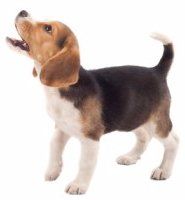
Example of Training for a Specific Bark
There are many reasons why a Beagle will bark, however one of the most common is a triggered disturbance.
Disturbance Barking
With disturbance barking, a certain noise is picked up a dog and it causes some type of aggravation or frustration. For this example, we will use the element of a siren (car alarms, fire trucks and so forth). Since a dog's hearing is so heightened, a Beagle can quickly feel severe aggravation and unrest when there is a sudden, high pitched noise.
Envision if without warning, someone blew a whistle directly into your ear and continued doing it for a while! This is how your Beagle most likely feels when hear a siren.
If a siren is just a very occasional event, perhaps 1 time per month, you can use simply calming techniques.
1)
If you are outside, bring your dog inside. Whether outside or inside, do not scold your Beagle. This reaction is not due to "bad" behavior. Reassure your dog that everything is alright. Talk in a matter-of-fact voice and gently pat him. Your tone of voice and your actions will be your dog’s cue to know if he or she should be “on alert”.
If you remain very calm and act as if all is fine, your dog will learn to mimic you. If you run around closing windows, covering your dog’s ears, etc…this is signaling to your dog that something is indeed “wrong”, thus causing them to bark even more.
2)
If you live in an area that is very noisy with car alarms and sirens always going off, you may wish to attempt to train your dog to cope by desensitizing him or her. This is done by slowly exposing the dog to a noise until he learns that hearing it is not reason for concern. For some Beagles, this can work amazingly well and for others it will at least allow the dog to calm down a bit.
You would obtain a small siren. We have found that using a smoke alarm works well. Duct tape is put over the siren where the noise emits. Use as much as you need so that the end result is that the sound is 1/5 of the normal noise volume when you press the button. Test this before you begin. This training will not end with the maximum noise being emitted since a noise that loud can be quite painful. A certain amount of duct tape will always be used.
You would sit down with your dog and press the alarm. The tone of your voice and your actions must show your Beagle that there is no reason to be on high alert. If the dog responds well to the low level siren, you should reward him or her with tons of praise and treat.
Work with your Beagle each day. Slowly raise the noise level every 2 weeks by taking away a layer of the tape. As time goes by, be in a different room and do not allow your dog to know when you will be implementing the training.
NOTE:
Do not have the siren at full noise capacity and hold it up to your Beagle's ears as this could cause injury to the ear drum. Once you have worked your way up to turning on the siren at unexpected times, your Beagle will have become adjusted.
Barking Correctors
Sometimes dogs can get stuck in a loop of barking. When there is nothing that brings their focus away, it can be hard for a Beagle to calm down. In some cases, clapping or speaking to a dog can work; but in some instances, a dog can interpret this as attention. If an owner yells or firmly says 'No!' or 'Stop it!', this can sometimes be misinterpreted as the human joining in!
So, you may find that using an interrupter spray helps stop barking. Unlike shock collars or high pitched noise devices which are just terrible and never recommended, these work by releasing a quick burst of compressed gas to halt not just barking, but also such things as jumping up or taking chase.
Tip:
This is not to be sprayed at the dog; you point it away and just give it a quick burst. Ones like The Company of Animals Pet Corrector
 are chemical free, are not too loud and are completely safe. For many dogs, this stops barking immediately.
 are chemical free, are not too loud and are completely safe. For many dogs, this stops barking immediately.

Reader Q&A
Q: I have a 2 year old Beagle girl, unaltered, and since picking her up from the most recent boarding (at a new boarding facility) I've noticed her howl has changed. Prior to me leaving for a Labor Day trip her bark and bay/howl was a high pitched, shrill, almost ear piercing sound.
Now upon picking her up and bringing her home I didn't recognize the howl I was hearing outside. I thought it was another dog. When I went out to see what dog was howling like that, I noticed it was my Beagle girl. The howl doesn't sound bad, it sounds like a traditional low pitched beagle bay.
I just have never heard of a Beagles tone changing like that. When I look on the web for anything about a dog's voice changing I'm encountered with worrisome articles about a damaged vocal box or illness. Nothing about how this could be a normal thing so that concerns me that perhaps the boarding place did something to her because she was just too loud for them. That could be my own crazy overprotective beagle parent instinct!
I had a male Beagle for over a decade and he just passed recently; he was 12 yrs. old and he and my female lived happily together for almost 2 years. Her tone now sounds similar to his lower toned bay.
Should I be concerned or is this normal for a Beagle (specifically a female) to develop a deeper howl as they age? I didn't notice such a change with my male but I was a young college kid back then so I wasn't quite as perceptive.
A:
You bring about a very interesting question. It is normal for a Beagle to change the pitch of their howl depending on the trigger for the vocalization. For example, a howl in response to hearing sirens (remember that your Beagle will hear things that your ears simply cannot pick up) will be a different tone than a howl sent out to call for other dogs.
As long as she is not showing any signs of health issues
such as Voice Box Paralysis, which includes a very hoarse sounding bark, coughing and/or breathing problems, this is most likely due to your Beagle howling differently in response to a change in the environment; regardless of whether you can pick up those changes or not.